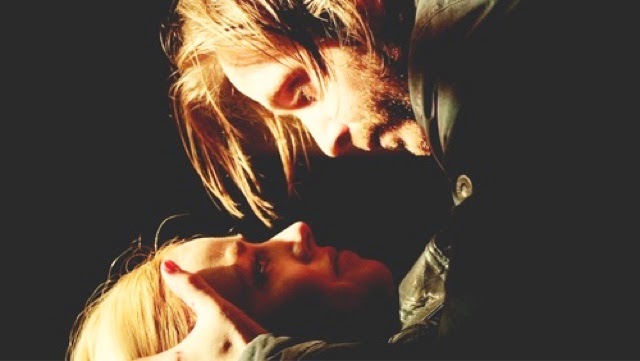
Fear the Walking Dead aired at 9pm on AMC Sunday nights until this week; it'll be replaced by The Walking Dead starting next week.
From a slow start with a dumb name, how far have we gone with Fear the Walking Dead?
This week, everyone finally really gets their shit together and leaves the neighborhood...though they do it in a distressingly sociopathic way that no one really questions all that much, and that's worrying. Daniel opens up that stadium and releases, what, ten thousand dead sports fans? Twenty thousand? It effectively turned the show from Zero Zombies Here to All The Zombies Here, and it got them through the soldier barricade before the soldiers could enact whatever vague clean-up plan they had, but it also will have swamped their homes, and no one fought the idea of not telling the neighbors. That's hateful. They were all "they did nothing" about the soldiers taking people in the night, but not one of the main characters ever shared all of their knowledge and built a feasible idea of what was actually going on. Not with each other, and certainly not with their neighbors, who were literally as scared and confused as they were, and were 100% in the same situation.
It makes it very hard to care about people who don't care about anyone else.
But they get out. And they head to the Facility to save their family members that were taken, so at least there's that. Doctor whats-her-face calls for an evac before the cleanup, but because of the stadium horde, there's delays that get people killed and cause hysteria, and she loses hope and takes out a lot of the patients. Travis and the adults break in the side door and make it to the holding pens, where they free as many of those people as they can...even though three minutes ago, they let all their neighbors die in ignorance. Nick and Strand make their move before that when the soldiers and doctors are distracted, so that they're stuck like idiots in a closed hall full of biters when Team Travis arrives. The same Team Travis that left everything they own in the care of Alicia and Chris who might one day be cool fighters but now have no training and know weapons, so that when some AWOL soldiers show up and harass them and threaten Alicia's virtue, they have to give up one of the cars--with all their stuff and supplies in it. Liza, meanwhile, runs around staring at the destruction, and somehow manages to show up at exactly the same time as everyone else so that they can all be reunited conveniently without having to look for each other, and uses her pass card to get them through the building and back to the cars. Where Soldier Andy pops up out of nowhere, shoots Ofelia, and gets his face beat in my Travis.
Thank god Strand has a plan, because these people are a mess.
They take bizarrely empty roads through a dark and burning LA (and when was the last time there were ever empty roads in LA?), to the beach, where Strand has a huge modern mansion with a generator and is "prepared for this", whatever that means. He's also got a yacht off the beach, and his plan is to get there. Since these guys helped him out and kept him alive, they can come with him.
But nothing is ever that easy. Liza, somehow, when we weren't looking, was bitten on her hip but doesn't have any other injuries and wasn't ever pulled down and eaten, but she knows what that means. She wants Maddie to take care of her, because of their pact to not let Travis do it to either of them--and then they both just throw that out the window by not protesting at all when Travis takes the gun and does it.
So the season ends with, out of that whole group, two women dead, one woman injured and trying not to die of an ordinary infection to rise from an extraordinary one, and and extra man. Which is annoying.
These characters spent a whole season being inconsistent and not sharing what little information they have at all, and then are surprised when people get killed or turn on them. It's one thing to argue that they don't know anything about a zombie apocalypse; it's something else to write off that they're all bad friends, selfish jerks, unanimously bad at asking the right questions or sharing what little info they have, and then asking us to care for them. As said above, it's very hard to care for people who only care about themselves and can't even keep that straight. So far, Strand, after his first episode, is the most interesting, and he makes the others more interesting just by interacting with them. The lesson of that seems to be, if you're going to be self-interested and selfishly murderous, at least commit to it and do it with style. Don't act like there's anything else there.
On the other hand, the city, when we get to see it, is a neat setting; there should be piles of other people around, fighting and surviving, and maybe some of them will be more sympathetic, this close to the collapse, where people should still have humanity and be trying to start over. It's way too early for all this back-stabbing and sociopathy.
The dry hot desert should make for some neat, dried-up zombies, the water might make for some gross drowned ones out there in the kelp, and the idea of having the first "road" season actually be on the water like some weird Waterworld analog could be cool. And maybe getting them out and active instead of penned in by someone else we don't see enough to really know what they're even doing will take care of the passivity of these characters--they can't rely on the soldiers to keep them safe anymore, and if any of those soldiers survived, they're gonna be ticked and know who to blame for what happened. Or any of their neighbors, for that matter.
It was not a terrible first season. It was just a frustratingly inconsistent one, It was being sold to us as a realistic look at the fear and trauma of the world collapsing, but inside of that fear and trauma, they weren't doing all that much to shore up their defenses by, say, teaching their kids what they needed to do to survive? Or even paying all that much attention to where their kids even were? They talked a lot about pacts and sticking together, and then never did anything you'd need to keep those pacts--like, sticking together or keeping their pacts. Are we supposed to really believe that not a single one of them would have wanted to learn how to fight? That they wouldn't have asked each other specifically what they saw and compared notes in any of those nine days of downtime? That none of them would have talked to someone outside the group and figured out what they saw? That no one would have thought about where to get food and water? They did a good job of worrying about medicine, and being resourceful about it, but other than that, not even the ones who were established as once having to start with nothing did much about supplies.
The thing that rankled most, however, was that the people making and pushing the show seemed to equate "these people don't know what's happening" with "the viewer doesn't know what's happening"--which isn't true. We've all watched half a decade of the other show, we've seen much worse than this, and it's frustrating and dull to have the focus on the show so firmly on the level of "none of that has happened yet" when we know it will.
It's a storytelling choice that makes the show as a whole look like it's pulling punches; there's all sorts of ways they could have shown us stuff that the characters don't know--through the soldiers, through barely-received radio or walkie-talkie messages (more than just that one good scene), through people from outside washing up at the gates and asking for help, through any of the characters from other parts of the city that disappeared and were never seen again--and instead, we were given this narrow, closed-off, mostly-threat-free and basically safe sliver while all the interesting stuff happened somewhere else. It was a set up that was not effectively used.
What happened to Tobias and the implied bad life he had? How would those people act as everything fell apart? What happened to any of the students and their families for that matter, or any of the other teachers?
How many of the soldiers were as scared and freaked out as the people, and how many were freakishly happy to run around being gun-toting jerks? All we saw was a uniformity of gun-toting jerk. And how many of them saw what was going on in other parts of the city and had different views about how it was being handled?
Why are all the people we're following basically of the same class, in a city where there's all sorts of classes, races, lifestyles, and a history of falling apart along those lines when things get rough? We saw a riot early on, but all the people involved were very much faceless and none of them had much to do with the story.
Maybe next season will take better advantage of the opportunities this season fumbled. There's a hint of that with the set up of the boat, and Nick saying that he's bascally been living his own apocalypse since he became a drug addict; maybe there will be other rich people trying to do something about the end, and other drug addicts applying their street-learned skills to survive. Maybe there will be poor neighborhoods held together by their shared goals, or mobsters holding things together with the force the cops and soldiers couldn't give them, or branches of the military that aren't just gross caricatures and who are still trying to keep people safe instead of preying on them across the board. Maybe there will be survivalists up in the hills or out in the country who already know how to handle collapses because they've actually prepared for this. It's California. There should be all sorts of interesting and strange and varied people to encounter, now that everyone is all mixed up together!